
Landscaping Services Near Me: How to Choose a Landscaping Company in Aurora, IL
If you have typed "landscaping companies near me" or "landscaping services near me" into your phone, you already know the problem: the results are a wall of companies that all say the same things. Everyone is "family owned," "affordable" and "fully insured." Very few of them tell you what you are actually buying, how the work should be done, or how to tell a good quote from a thin one.
This guide is written for homeowners and property managers in Aurora, Illinois and the surrounding Fox Valley and western suburbs. It explains what landscaping services really include, why choosing a local company matters in northern Illinois, what the state requires of contractors in a few specific areas, and the exact questions that separate a reliable landscaping company from a risky one. It also explains how GoldLeaf Landscape | Hardscape approaches the work, so you can compare us the same way you would compare anyone else.
What "landscaping services" actually means
"Landscaping services" is one of the broadest phrases in home services. Two companies can both call themselves landscapers while selling completely different things. Before you compare anyone, work out which category of work you actually need.
- Maintenance. Mowing, edging, cleanups, mulching and seasonal upkeep. It is recurring, low-ticket work, and many companies in your search results do only this.
- Design and installation. Planting plans, beds, grading, drainage and outdoor living layouts. This is a planning-heavy service where the quality of the design matters as much as the labor. See our backyard design services in Aurora.
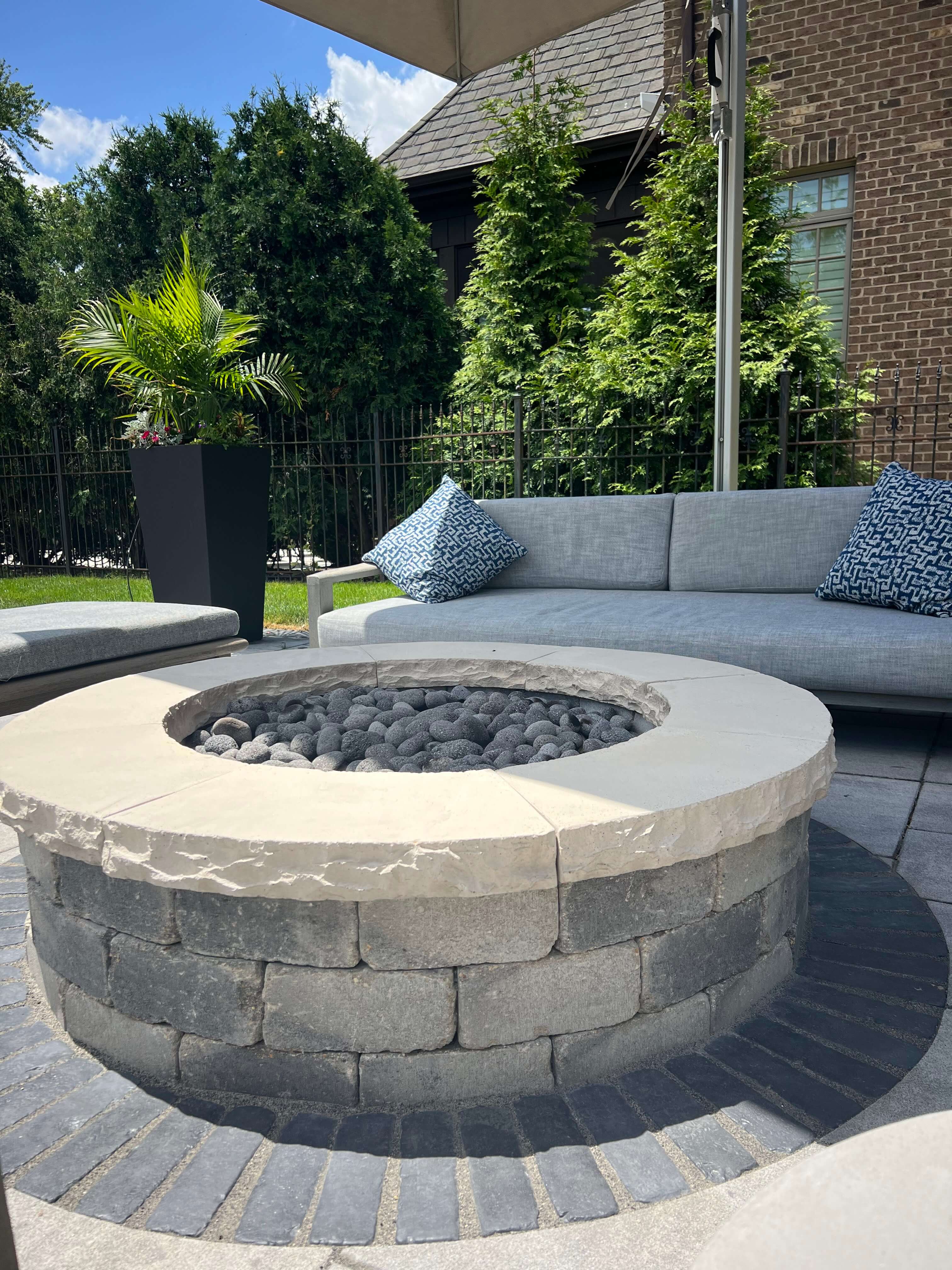
- Hardscaping. Paver patios, walkways, driveways, steps, retaining walls and fire pit areas. This is construction, and it is where most of the cost, and most of the risk, sits. See brick paving and patio installation.
- Sod and lawn installation. Removing a failed lawn, preparing soil and laying sod for an instant lawn. See sod installation in Aurora.
- Commercial landscaping and snow. Ongoing property care for businesses, HOAs and multi-unit properties, including winter work. See commercial landscaping and commercial snow plowing.
You can see the full list on our services page. The reason this breakdown matters for your search is simple: a company that is excellent at weekly mowing is not automatically qualified to build a retaining wall, and a hardscape crew is not automatically the best choice for a weekly maintenance route. Ask any company you are considering which of these it does every day, not which ones it is willing to do.
Why "near me" matters more than it sounds
Search engines show you nearby companies because proximity matters, but it is worth understanding why, so you can use it as a real filter and not just a keyword.
Northern Illinois soil and weather are hard on outdoor work. Winters here involve repeated freezing and thawing, and heavy clay soils hold water. A patio, wall or walkway built on a poorly prepared base can shift or settle after a few winters. A company that works in your area every season sees how its own projects hold up and builds accordingly. A company that travels in from elsewhere may not.
Local companies know local requirements. Cities and villages handle permits for patios, walls, drainage and fences differently. The City of St. Charles, for example, publishes its own patio permit sheet, and Naperville publishes its own rules for when a patio permit is required. We have written about those in our guides for Naperville, St. Charles and Batavia. A local company has handled these questions before. It is still your responsibility to confirm requirements with your own city or village before work starts.
You can see local work in person. This is one of the most useful advantages of hiring nearby. The National Association of Landscape Professionals advises homeowners to inspect past work, visit a job in progress if possible, and ask to see a project similar to yours. That is far easier when the company's projects are in neighborhoods you can drive through. You can browse our project gallery and read our customer reviews before you ever call.
Response time and accountability are better close to home. If something needs attention after the job is done, a local crew can come back without a long trip, and a local company has a reputation in the same community where you live.
How to compare landscaping companies near you
Most people compare by price first. That is understandable, but it is the weakest filter. The National Association of Landscape Professionals' guidance for commercial properties specifically warns against choosing only on the lowest estimate, because a low bid may reflect incomplete knowledge of the job or inexperience. The same logic applies at home.
Here is a more useful way to compare.
1. Compare scope, not totals. Two quotes that differ by thousands of dollars almost always differ in what is included. One may include excavation depth, base material, edge restraints and drainage work. The other may not mention them. Ask each company to list those items.
2. Ask what happens underneath. For hardscape work, the visible surface is the smallest part of the job. The Concrete Masonry & Hardscapes Association's guide specification for interlocking concrete pavers recommends compacting the subgrade and the aggregate base to at least 98% standard Proctor density for pedestrian areas and residential driveways. It also says not to use bedding sand to fill depressions in the base, and not to install sand and pavers over frozen base materials. A company that can explain its base preparation in plain language, and tell you how it handles winter scheduling, is telling you something important about its standards.
3. Ask for references and look at completed work. The National Association of Landscape Professionals recommends asking for a list of references and professional affiliations, getting referrals from friends and neighbors, and asking how long the company has been in business and about the experience of its staff.
4. Ask about licensing and certification where it applies. More on this in the next section.
5. Get everything in writing. The same association advises getting written details before you agree to anything, covering the design, plant materials, all costs, a timetable and payment terms.
6. Ask about the warranty. Our own workmanship warranty is 5 years. Whatever a company offers, get the terms in writing: what is covered, for how long, and what you need to do to keep it valid.
Licensing, insurance and contracts in Illinois
This is the area where homeowners most often assume a protection exists that does not, so it is worth being precise. None of this is legal advice. Where we are unsure how a rule applies to a particular project, we say so.
Pesticide and herbicide applications
According to University of Illinois Extension, you need a pesticide license in Illinois if your business offers pesticide application services, and anyone applying general-use pesticides for hire must be licensed as required by Illinois law. Fertilizer alone does not require a license. Extension also explains that a company needs at least one licensed Commercial Applicator, and that the applicator's license categories, such as Turfgrass, determine where the company can legally apply pesticides.
What this means for you: if a company offers weed control or other treatments, ask whether the person doing the application is licensed. If a company only does installation and construction, this may not apply to your project at all.
Written contracts for home repair work
The Illinois Attorney General publishes the Home Repair and Remodeling Act and a consumer rights pamphlet. Under the Act, for work over $1,000 the contractor must give you a written contract or work order for signature before starting. That document must state the total cost, with parts and materials listed with reasonable particularity, any charge for an estimate, and the business name and address. The pamphlet also describes a three-business-day right to cancel for sales made at your home.
The Act also sets minimum liability and property damage insurance levels for home repair contractors covered by it, with an exception for contractors whose net worth is at least $1,000,000 based on a recent financial statement. We cannot tell you whether the Act applies to your specific landscaping project, because that depends on how the work is classified. The practical advice is the same either way: ask for a written contract that describes the work and the cost, and ask for proof of insurance. If you want to confirm how the law applies to your project, contact the Illinois Attorney General's consumer protection resources.
Insurance
For commercial properties, the National Association of Landscape Professionals advises asking whether a company has insurance to protect both its employees and your property. This is just as relevant for residential work. A crew that is digging, moving heavy materials and running equipment on your property should be insured for that work, and you should be able to see proof.
Hardscaping: where quality is hardest to see
Because most landscaping companies near you offer some version of hardscaping, this is the service where it pays to ask the most questions. Pavers, patios, walkways and retaining walls are permanent structures. When they fail, they fail slowly, and by then the contractor's quote is long forgotten.
Here is what to ask about any paver or patio project.
- How deep will you excavate, and what base material will you use? The right answer is specific, not "whatever is needed."
- How is the base compacted? Industry guidance calls for compaction to at least 98% standard Proctor density for pedestrian areas and residential driveways.
- How do you handle drainage? Water that has nowhere to go will move your base. A good plan sends water away from the house and does not push it onto a neighbor's property.
- What edge restraint will you use? Edges hold the whole surface together.
- Will you schedule around frozen ground? Industry guidance says sand and pavers should not be installed over frozen base materials, so a reliable contractor will not promise a January patio.
- What is the warranty? And what does it cover?
If a company cannot answer these clearly, keep looking. We use these same questions to explain our own process on our brick paving and patio installation pages.
Call 811 before anyone digs
Before any digging project, a locate request should be made through JULIE, Illinois' one-call service. JULIE says contacting it is a free service, that Illinois law requires underground utility lines to be marked before you start digging for any outdoor planting, building, adding or repair work, and that you can request a locate by calling 811 or (800) 892-0123, or online. JULIE also advises waiting until all lines are marked, and digging carefully within the tolerance zone because the marks are approximate. Ask any contractor who will make the locate request, and when.
Permits
Permit rules for patios, walls and drainage vary by municipality, and the rules differ even between neighboring towns. The City of Naperville, for example, requires a permit for patios over 500 square feet, and for any size patio with a permanent fire pit, fireplace or grill, among other conditions, while the City of St. Charles requires a building permit for any outdoor patio with no size threshold. Aurora, North Aurora, Montgomery, Oswego and every other nearby community has its own process. Always confirm with your own city or village before work begins, and ask your contractor whether they will handle the application or whether you need to.
Sod and lawn installation: timing and aftercare
Sod is one of the fastest ways to turn a damaged or bare yard into a usable lawn, and it is one of the services people search for most often. It is also one where timing and aftercare make a large difference.
The Illinois-Indiana Sea Grant's guide to seed versus sod says the ideal planting time for new lawns in Illinois is the fall season, and that installation during intense heat should be avoided because sod is intolerant of drought. It also says sod should be planted within 24 hours of harvest, that a soil test before installation helps determine needed fertilizers and soil amendments, and that sod is not grown for shady sites.
On watering, the same guide recommends watering newly laid sod thoroughly for 30 minutes after installation, irrigating daily for 10 days to 2 weeks until roots are established, and then watering thoroughly two to three times per week, with no more than about an inch of water per week needed.
What this means for your decision:
- Ask when the sod is delivered and installed. Sod that sits on a pallet for days is a warning sign.
- Ask what soil preparation is included. Laying sod over compacted or weedy ground is the most common reason it fails to root.
- Ask for written watering instructions. The first two weeks are the most important part of the job, and the homeowner does most of the work.
- Be honest about shade. If your yard is heavily shaded, ask what a contractor recommends instead of simply laying sod.
You can read more about our process on our sod installation page.
Backyard design: why the plan comes first
A backyard that is built piece by piece, a patio this year, a wall next year, a fire pit after that, often ends up with grade changes that do not line up, drainage that fights itself and materials that do not match. A single plan prevents that.
Good backyard design starts with how you want to use the space: dining, a fire pit, a play area, a quiet corner, an outdoor kitchen. It then works out circulation, drainage, sun and shade, privacy, and how everything will connect to the house. Even if you build in phases, the plan lets each phase fit the next.
When you are comparing companies, ask whether design is included, how it is presented to you, and whether you will see a layout before you commit. Our Naperville and Oswego guides go deeper into how design decisions play out on local lots. For a deeper walkthrough, read how to design outdoor living spaces.
Commercial landscaping and snow: a different kind of hiring decision
If you manage a business, HOA, condo association or multi-unit property, you are hiring for reliability over time, not a single project. The questions are different.
The National Association of Landscape Professionals' guidance for choosing a commercial landscape contractor recommends:
- Define what you want before requesting bids. What works for a restaurant may not work for a hospital or an office building.
- Ask other property owners for recommendations, and look for firms that have worked with businesses like yours.
- Confirm insurance that protects both the company's employees and your property.
- Do not choose on the lowest estimate alone, and allow time for results, since serious landscape problems take time to correct.
For winter, add questions about response time, how storms are triggered and tracked, what the contract says about repeat visits, and who you call at 5 a.m. when something is wrong. Our commercial landscaping and commercial snow plowing pages explain what we offer and how to ask for a property walk-through.
Red flags when you are searching
Not every issue means a company is bad, but these are worth slowing down for.
- No written scope or contract. Especially on any project large enough to involve excavation or materials.
- Pressure to decide today. A reasonable quote does not expire the moment you walk out the door.
- A large payment demanded up front with no stated payment schedule. Payment terms should be written down.
- Vague answers about base preparation, drainage or warranty. These are the details that decide how long the work lasts.
- No references or no completed work you can see.
- No clear answer about insurance or licensing where it applies to the service.
- A quote far below the others with no explanation. Ask what was left out.
How to read a landscaping quote
When quotes come back, line them up side by side on a piece of paper and check for these items. If an item is missing from one quote and present in another, ask why.
- Total price and how it is broken down between labor and materials
- Materials listed by name and type, such as paver style, base material and edge restraint
- Excavation and haul-away of old material
- Drainage work
- Who requests utility locates and who handles permits
- Start date, estimated duration and what happens if weather delays the job
- Payment schedule and the method of payment
- Cleanup and restoration of the surrounding yard
- Warranty terms in writing
A quote that is clear about all of these is usually a sign of a company that has done the work many times.
Timing your project in northern Illinois
Different services have different best seasons. Sod installation is best in fall according to Sea Grant, which also says to avoid installing during intense heat. Hardscape projects need unfrozen ground, since industry guidance says not to install over frozen base materials. Design and planning work can happen any time of year, and many homeowners use winter to plan a spring build.
The practical point is that good companies fill their schedules. If you want a larger project done in spring or early summer, the planning conversation often needs to start well before that. Contact us at goldleaflandscape.net/contact to start a conversation about timing.
Where we work
GoldLeaf Landscape | Hardscape is based at 1004 Dearborn Ave, Aurora, IL 60505, and we serve Aurora, North Aurora, Naperville, Batavia, St. Charles, Geneva, Oswego, Plainfield, Sugar Grove, Montgomery, Wheaton and other communities across the Fox Valley and western suburbs. See the full list on our areas we serve page.
How GoldLeaf approaches it
We do not try to be the cheapest landscaping company near you. We try to be the one you do not have to call back about. In practice that means:
- A walk-through of your property and a conversation about how you want to use it
- A written scope that lists the work and materials
- Base preparation and drainage treated as the most important part of any hardscape job
- A 5-year workmanship warranty
- Clear communication about timing, permits and what happens next
If you would like to see how we work, browse our completed projects, read our reviews, or learn more about us. Our office hours are Monday through Friday, 8 a.m. to 4 p.m., and you can call 630-270-4324 or email info@goldleaflandscape.net.
Frequently asked questions
How do I find the best landscaping companies near me? Start by deciding which type of work you need, since maintenance, hardscaping, sod and commercial service are different specialties. Then ask for references, look at completed projects, confirm insurance and licensing where they apply, and compare written quotes by scope, not just by total price.
What do landscaping services include? Landscaping services can include maintenance, design and installation, hardscaping such as paver patios and retaining walls, sod and lawn installation, and commercial property care including snow removal. Not every company offers all of these, so ask which ones a company does regularly.
How much do landscaping services cost? Cost depends heavily on the type of work, the size of the project, the materials and site conditions such as grading and drainage. A fair comparison needs written quotes that list the same scope. If one quote is far lower than the others, ask what is not included.
Do landscapers in Illinois need a license? It depends on the service. According to University of Illinois Extension, a pesticide license is required in Illinois if a business offers pesticide application services, while fertilizer alone does not require one. Other work, such as installation, is not covered by the same pesticide license. Ask any company what licenses and insurance apply to the work you are hiring them for.
When is the best time to install sod in Illinois? The Illinois-Indiana Sea Grant guide says the ideal planting time for new lawns in Illinois is the fall season, and that you should avoid installing sod during intense heat. New sod then needs consistent watering for the first two weeks while roots establish.
Do I need a permit for a patio or retaining wall? It depends on your city or village. Some communities require a permit for patios above a certain size or with certain features, and some require one for any patio. Always check with your local building department before work begins, and ask your contractor who will handle the application.
Should I call 811 before a landscaping project? Yes. JULIE, Illinois' one-call service, is free, and Illinois law requires underground utility lines to be marked before you start digging for outdoor planting, building, adding or repair work. Call 811 or (800) 892-0123, or submit a request online, and wait until all lines are marked.
Does GoldLeaf offer free consultations?
Yes. You can contact us at 630-270-4324 or through our contact page to schedule a walk-through. You can also see more answers on our FAQ page.
Get Your Free Estimate Today for your Landscaping Project
Contact GoldLeaf Landscape for your properties luxury outdoor living project.