
Landscaping and Hardscaping in Naperville, IL: A Homeowner's Planning Guide
Naperville has become one of the more design-driven communities in the western suburbs: a mix of established neighborhoods near the Riverwalk and the DuPage River, and newer developments further out toward 95th Street and Route 59, each with its own landscaping needs. Whether you're planning a full backyard redesign or researching what a landscaping company in Naperville can actually do for your property, this guide covers what's worth knowing before you start: how design works, why the hardscape comes first, what the City requires, how to choose plants, and how to avoid the mistakes that cost homeowners the most.
What does "landscaping design" actually include?
Landscaping design is the planning process that happens before any construction begins. It maps out how hardscaping, plantings, drainage, lighting and outdoor living features work together on your specific property. For a Naperville homeowner, that often means accounting for grade changes near the river corridor, mature trees in older neighborhoods, or wide-open blank-slate yards in newer subdivisions.
A complete design plan typically answers these questions before a single paver is ordered:
- How will you use the space? Dining, lounging, a fire feature, an outdoor kitchen, kids and pets, or all of the above each call for different layouts and square footage.
- Where does the water go? Every patio, walkway and wall changes how rain moves across a lot. Drainage is planned first, not patched in afterward.
- What stays and what goes? Existing trees, utility lines, easements and setbacks shape what's possible.
- How will it look from the house? Sightlines from kitchen windows, patio doors and the street decide where focal points like fire features and plantings belong.
- What's the phasing? Some homeowners build everything at once; others stage the project over two or three seasons. A good plan makes phasing possible without tearing out finished work.
A good design plan isn't just a sketch of where a patio goes. It's a full picture of how the property will function once it's built. Our backyard design service starts with exactly this kind of planning, and you can see how finished designs turn out in our project gallery.
Why hardscaping is the foundation of most Naperville backyard projects
Hardscaping, meaning brick pavers, retaining walls, walkways and patios, forms the structural backbone of most backyard upgrades, because it's the part of the project that has to be engineered correctly the first time. Plants can be replaced or replanted. A failed patio base means pulling the surface up and starting over.
What separates a patio that lasts from one that doesn't
Northern Illinois winters put real stress on outdoor surfaces. Water gets into small gaps, freezes, expands and thaws again, season after season. A hardscape installed without proper base preparation and drainage planning is far more likely to crack, shift or settle unevenly within a few years.
Industry guidance backs this up. The Concrete Masonry & Hardscapes Association's guide specification for interlocking concrete pavers recommends compacting both the subgrade and the aggregate base to 98% standard Proctor density for pedestrian areas and residential driveways. It also states that bedding sand should never be used to fill depressions in the base, because the base sets the final paver elevations. The same document notes that installers should not place sand or pavers over a frozen base or during heavy rain or snow, which is one reason professional installers schedule around the weather instead of rushing a job.
In practical terms, that means the unglamorous work underneath the surface (excavation depth, compacted aggregate, properly set edge restraints, correct slope away from the house) is what you're really paying for. It's also the part you can't see after the project is finished, which is why asking an installer to describe their base process is one of the best questions you can ask during a quote.
Pavers vs. poured concrete vs. natural stone
Most Naperville homeowners compare three surface options:
MaterialStrengthsTrade-offsBrick and concrete paversIndividual units flex with the ground and can be lifted and re-set if a section settles; wide range of colors, textures and patternsRequires a properly built base; joints need periodic sand top-upsPoured concreteLower upfront cost for basic slabsCracks as the ground moves and is difficult to repair invisibly; limited design optionsNatural stoneDistinctive, high-end lookHigher material cost; some stone is more slip-prone or porous than others
For most residential patios, walkways and driveways in our service area, interlocking pavers offer the best balance of appearance, repairability and longevity, which is why brick paving is the core of what we build.
Retaining walls, steps and grade changes
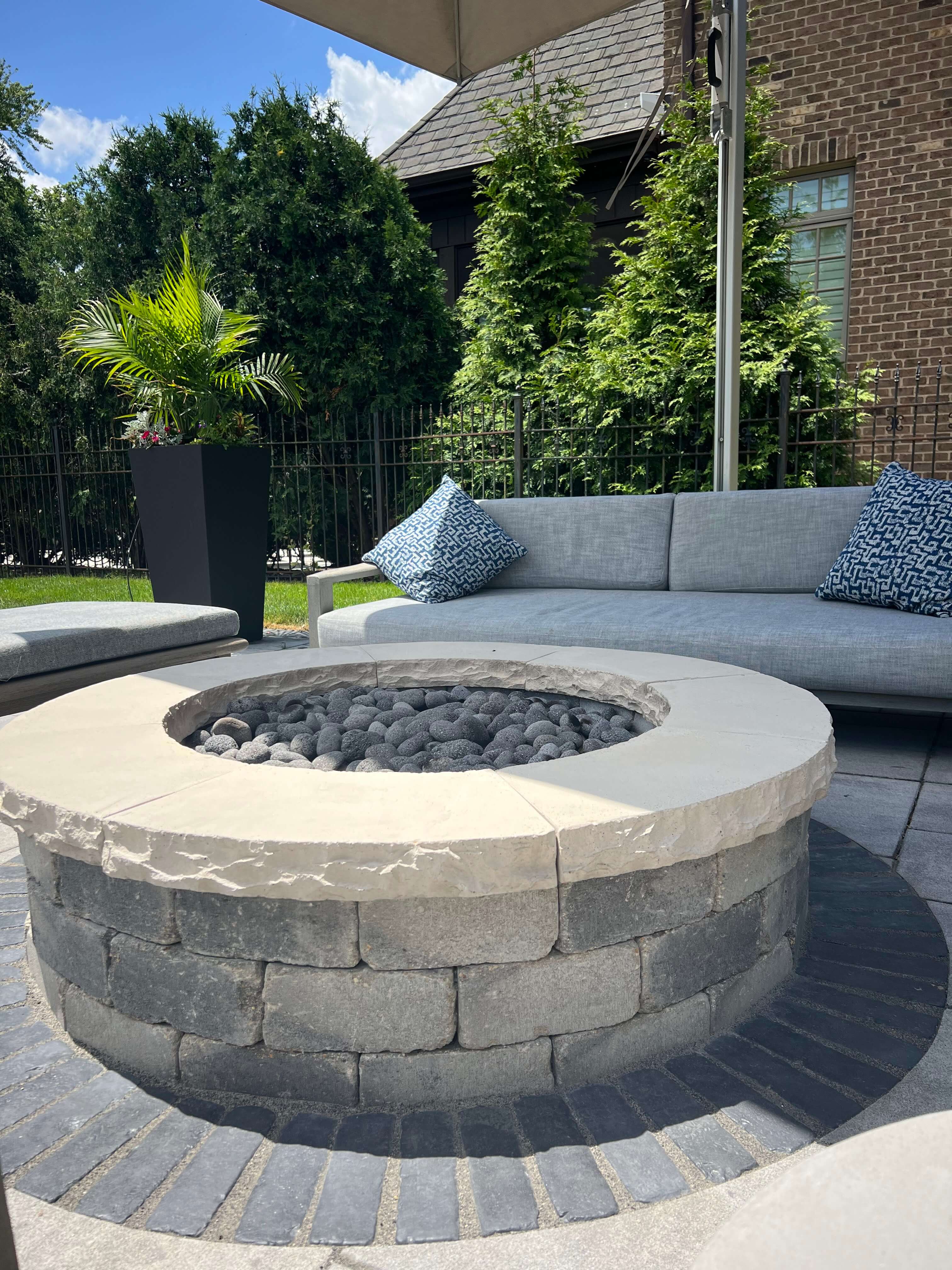
Retaining walls and tiered steps are especially common on Naperville properties with grade changes, particularly near the DuPage River corridor and in neighborhoods with sloped lots. They do more than hold soil. They create level, usable areas out of sloped ground, direct drainage and add built-in seating or planting space. The raised planter and capped wall in our featured Naperville project photo show how a wall can frame a patio and define a planting bed at the same time.
Because walls hold back soil and water, they need engineered drainage behind them (compacted base, drainage aggregate and a way for water to exit). This is why we design every hardscape project around the specific lot it's built on rather than a generic layout.
Backyard transformations: combining hardscaping, patios and sod
Many Naperville homeowners start out asking about one feature, such as a patio or a fire pit, and end up realizing a full backyard transformation produces a more cohesive result than tackling pieces separately over several summers. Building the patio, walkway, wall, planting beds and lawn as one plan avoids a common problem: a new patio surrounded by tired turf and bare soil, or a new lawn that gets torn up by a later construction project.
Combining hardscaping with fresh sod installation around the new patio or walkway gives the whole yard a finished look in one project, rather than a patchwork of old and new. Sod also establishes far faster than seed, which means a usable lawn within weeks instead of a full season of waiting.
Popular features we're asked about most often in Naperville:
- Paver patios sized for both a dining set and a lounge area
- Fire pits and fire tables, built into the patio or set as a separate gathering area
- Outdoor kitchens with built-in grills, counters and refrigeration
- Seat walls and retaining walls that double as planters
- Walkways and front-entry upgrades that improve curb appeal
- Low-maintenance planting beds with mulch or stone edging
Choosing plants that survive Naperville winters
A beautiful patio surrounded by plants that struggle in our climate is a short-lived investment. Plant selection starts with hardiness zone, soil, sun and moisture. Local conditions matter more than what a big-box garden center happens to stock.
The Morton Arboretum, located just up the road in Lisle, offers a free searchable plant database that lets you filter trees, shrubs, perennials and grasses by USDA hardiness zone, mature size, light exposure and soil type. You can also filter for tolerance of clay soil, road salt, drought and wet sites, all of which matter in this region. It also publishes curated lists such as Midwest natives and shade-tolerant shrubs.
A few practical principles we follow when designing planting beds:
- Match the plant to the conditions. Heavy clay, full afternoon sun and wet spots each narrow the list of plants that will thrive.
- Use structure plants for year-round form. Evergreen and boxwood-style shrubs hold shape through winter, so the yard doesn't look empty from November to April.
- Layer for seasonal interest. Mixing spring bloomers, summer perennials and fall color keeps the landscape interesting across seasons.
- Plan for mature size. A small shrub planted too close to a patio edge becomes a pruning chore in three years.
- Consider mulch or river rock edging. Both reduce weeding and help retain moisture, and stone borders pair well with paver and wall materials.
Drainage: the part of the design nobody sees
Drainage problems are the most common reason a good-looking project goes wrong. Every hard surface sheds water instead of absorbing it, so a new patio or walkway needs a deliberate path for that water: slope away from the home, a way to move runoff across the yard, and places for it to go that don't flood a neighbor's lot or your basement window wells.
Common drainage tools include a properly sloped patio surface, swales, catch basins, drain tile and French drains, and planting beds sized to absorb some runoff. If your yard already holds water after storms, it's worth addressing that during design, because it's far cheaper to build the solution into the new hardscape than to retrofit it later.
Permits, utility locates and what to confirm before you build
Several steps happen before work starts, and good contractors help you through them.
Permits. The City of Naperville requires a permit for certain patio projects. According to the City's deck, patio and exterior improvements permit page, a permit is needed when the total paved area will exceed 500 square feet, and regardless of size if the design includes a permanent fire pit, fireplace or grill, if the patio sits more than 30 inches above the adjacent ground, or if it includes electrical, plumbing or gas fixtures. All patios must also follow the City's setback and easement restrictions. Fences, driveways and other exterior projects may need separate permits; the City's building permits page lists what applies and how to apply online. For questions about retaining walls, grading or drainage, the City's Building Permits office can be reached at (630) 420-6100.
Which side of town you're on. Naperville spans both DuPage and Will County, and requirements can differ depending on where your property falls. This is one of the details worth confirming early in planning rather than assuming one answer applies everywhere in the city. Your HOA may also have its own architectural review process, so check your covenants before finalizing a design.
Utility locates. Illinois law requires underground utilities to be marked before digging. JULIE (811) provides this as a free service, and requests can be submitted online or by phone at any time. Your contractor should handle the locate request, but it's worth confirming that it's part of the scope.
What affects the cost of a Naperville hardscape or landscape project?
Every property is different, so we don't publish one-size-fits-all pricing. These are the variables that move the number most:
- Square footage and complexity. A simple rectangular patio costs less per square foot than one with curves, multiple levels or inset features.
- Site conditions. Slopes, poor soil, tree roots and tight access for equipment all add labor.
- Materials. Paver style, wall block, natural stone and edging choices all affect the price.
- Features. Fire tables, outdoor kitchens, lighting and water features add up quickly.
- Drainage and grading. The more water management a lot needs, the more excavation and materials are involved.
- Scope. Bundling patio, walls, planting and sod into one project is often more efficient than phasing it across years.
The most useful step is a site visit. Photos and measurements help, but a contractor can't responsibly quote around grade, drainage or access without seeing the lot.
How to choose a landscaping company in Naperville
Naperville has no shortage of landscapers, so the question is how to tell them apart. Ask about:
- Base preparation. Ask how deep they excavate, how they compact the base and how they handle edge restraints. A confident, specific answer is a good sign.
- Design process. Do they plan the whole property or just install what you describe?
- Local project examples. Look for finished work in nearby communities. Browse our projects and customer reviews to see how past clients describe the experience.
- Warranty. A written workmanship warranty shows that the installer expects the project to last. Ours is 5 years on every hardscape project.
- Permit and locate handling. Who pulls permits and calls JULIE should be clear before you sign.
- Insurance and references. Ask for proof of coverage and recent references.
If you want to read more about how we work, see our about page or our FAQ.
Commercial and HOA landscaping in Naperville
Naperville's mix of office parks, retail centers and HOA communities also makes it a significant market for commercial landscaping: design, installation and ongoing grounds care for property managers and associations who need a dependable, accountable provider rather than a rotating cast of subcontractors.
For commercial properties, the priorities are different from a single-family yard: curb appeal that supports leasing and resident satisfaction, safe walkways and entries, drainage that protects parking areas and foundations, and a maintenance program that keeps the property consistent from season to season. Our commercial snow plowing service extends that same accountability into winter, so one provider covers the property year-round.
Serving Naperville and nearby communities
We're based in Aurora, and Naperville is one of the communities we serve most often. Homeowners in neighboring towns often ask us the same questions, so you may also find these local pages helpful: Aurora, Warrenville, Wheaton, Downers Grove and Oswego. You can see every community on our areas we serve page. For more local project ideas, browse our blog, including our guides for Batavia and St. Charles.
Frequently asked questions
Do I need a permit for a patio in Naperville? It depends on the size and features. The City requires a permit when the paved area will exceed 500 square feet, and regardless of size when the patio includes a permanent fire pit, fireplace or grill, sits more than 30 inches above grade, or includes electrical, plumbing or gas. Confirm with the City before you build.
Are pavers better than poured concrete? For most residential projects, we recommend pavers because individual units can be re-set if a section settles, and they offer far more design flexibility. Either material depends on a properly compacted base to last.
When is the best time to build a patio or hardscape in Naperville? Installation is generally done in the warmer months, because base and bedding materials shouldn't be placed over frozen ground. Design and planning often start in late winter or early spring so projects can be scheduled when the weather allows.
Can I combine a patio with new sod in the same project? Yes, and we recommend it. Installing sod as the final step gives the whole yard a finished look and repairs any lawn disturbed during construction.
Do you offer free estimates in Naperville? Yes. We offer free on-site consultations for Naperville properties.
Getting started
If you're ready to move from researching to planning, GoldLeaf Landscape offers free on-site consultations for Naperville properties, backed by a 5-year workmanship warranty on every hardscape project. Call us at 630-270-4324 or request your free consultation to start planning your project.
Get Your Free Estimate Today
Contact GoldLeaf Landscape for your properties luxury outdoor living project.